Monday, January 18, 2016

For all Korean Spouses Working or Non- Working

Para sa lahat nang Korean Spouses  may trabaho or wala kung nl gusto ninyo magaral tulad nang Cosmeticolgy, Baking , Interior  Design , etc.
Pwede napo ito subukan at LIBRE  PO kailangan  lamang MARUNONG MAKAPAGSALITA at MAKAINTINDI NANG SALITANG KOREAN

ANO DAPAT GAWIN: Pumunta lamang sa pinakamalapit na Goyong Centers sa inyong lugar

Pagdating  dun sa Goyong Center: magtanong kayo kung saan po magaapply nang 취업 성궁 파키지 1

Mga Kailangan  dalhin pagkayo ppunta:
For F6 visa holder working or non working  : ARC ID & Marriage Registration  Certificate
(외국인등록증 & 호인관게증명서)
And if you're working please bring  your contract.

For Korean Citizen Holder : 기본증명서
And if you're working  please bring your contract

And after all the process the Goyong Center will give you a  approval certificate and you will bring to the nearest Nonghyup Bank and they will give you the 내일배음  카드

* please check photos  attached *
Or visit website: www.hrd.go.kr
Or call 1577-1000

Thank you

Monday, January 4, 2016

NPS COUNSELING CENTER FOR FOREIGNER


FOREIGNER NPS TELEPHONE COUNSELING CENTER

* Weekday 09:00am ~ 18:00pm (except during LUNCH BREAK)
* Chinese - 02-2176-8735
* Thai - 02-2176-8730
* Uzbek ( Russia) - 031-365-3086
* Indonesia - 02-2176-8734 / 031-365-3089
* Filipino - 031-365-3087

Ansan Center for Foreigners

Address : 1 Fl. World Tower, 10 shingilro 1gil, Danwongu, Ansan, Gyeonggido
  • - Zip code : 15402
  • - Phone number : 031-365-3082~3
  • - Transportation : Get out of Exit No. 1 at Ansan Station(Line No.4)
  • - Bus : 11, 22, 55, 909
  • - Parking Lot : Parking Lot of the building


  • Incheon International Airport Center


    Address : 272 Gonghang-ro, Jung-gu, Incheon-si(1st Fl. Zone A, Gate 2)
  • - Zip code : 22382
  • - Phone number : 032-743-5005~6
  • - Transportation : Incheon International Airport Station(Airport Railroad)


  • NPS International Center


     * Department International Service *
    Director - 02-2176-8701
    Customer service for Social Security Agreements-  02-2176-8702
    Overseas beneficiaries management - 02-2176-8703
    Global Service - 02-2176-8740

    NPS- National Pension Plan Coverage ( please ready every details)


    Coverage criteria

    (1) General criteria for coverage
    The general criteria for National Pension coverage are age and residence; income is not included. Accordingly, all Korean residents in Korea aged between 18 and 59, regardless of their income, are covered under the National Pension. Foreign residents residing in Korea whose ages are between 18 and 59 are also covered under the National Pension, apart from some exceptional cases (refer to “Foreigners and Lump-sum Refund”).
    (2) Who is excluded from national pension scheme coverage?
    Those falling under any of the following categories are excluded from national pension coverage, even if they satisfy the general criteria for coverage:

    Government employees, military personnel, private school teachers, specially designated employees working for post offices (they are covered under separate pension plans) and national pension beneficiaries aged between 55 and 59, such as early or old-age pensioners.
    (3) Exceptional cases
    Anyone aged less than 18 and working at a workplace covered under the National Pension may participate in the National Pension as a Workplace-based Insured Person, with the consent of his/her employer. Additionally, when an insured person with an insured period of more than 1 month reaches the age of 60 and wants to contribute continuously to be entitled to an old-age pension or to receive more pension, he/she may apply for continuous coverage under the National Pension before he/she reaches the age of 65.

    Categories of Insured Persons

    Those who are insured under the National Pension are largely divided into Mandatorily and Voluntarily Insured Persons. Mandatorily Insured Persons are subdivided into Workplace-based Insured Persons and Individually Insured Persons. The difference between Workplace-based Insured Persons and Individually Insured Persons is how the national pension contribution is made. The contribution for a Workplace-based Insured Person is equally shared by the employer and the employee, while the contribution for the Individually Insured Person is totally levied on the insured person.
    Voluntarily Insured Persons are subdivided into Voluntarily Insured Persons and Voluntarily & Continuously Insured Persons. They may participate in the National Pension upon his/her request.
    (1) Workplace-based Insured Persons
    The contribution for a Workplace-based Insured Person is equally shared by the employer and the employee. Acquisition or loss of insured status and payment of contributions are made by the employer. All employees and employers aged between 18 and 59 who are working at a workplace with one or more employees shall be covered as Workplace-based Insured Persons. Those who are aged less than 18 and working at a workplace covered under the National Pension may participate in the National Pension with the consent of their employers.
    (2) Individually Insured Persons
    The contribution for the Individually Insured Person is completely paid by the insured person. Acquisition or loss of insured status is done through application by the insured person. A person who is subject to the general criteria for coverage, but is not a Workplace-based Insured Person nor a Voluntarily Insured Person becomes an Individually Insured Person when he/she falls under one of the following categories:
    The self-employed; a person without any income aged 27 or older; a person without any income aged between 18 and 27 who has paid at least one month's contribution
    (3) Voluntarily Insured Persons
    A Voluntarily Insured Person is not subject to mandatory coverage but can acquire insured status upon his/her application, bearing the total contribution cost him or herself. All Voluntarily Insured Persons can be covered upon their request. In this case their monthly contributions would be determined by median or more value of the Standard Monthly Income of all Workplace-based and Individually Insured Persons, except for those protected under the National Basic Living Security Act. A person falling under any of the following categories may become a Voluntarily Insured Person.
    • A person without any income whose spouse is an insured person or a beneficiary under a public pension (Public pensions include the National Pension, Government Employees’ Pension, Military Personnel Pension, Private School Teachers’ Pension, and Specially Designated Post Office Employees’ Pension);
    • A person without any income who is less than 27 years old and has never paid any contributions;
    • A person protected under the National Basic Living Security Act;
    • Retired persons entitled to benefits under the Government Employees’ Pension, Military Personnel Pension, Private School Teachers’ Pension, and Specially Designated Post Office Employees’ Pension.
    (4) Voluntarily & Continuously Insured Persons
    A currently or formerly insured person loses his/her insured status upon reaching the age of 60. But those who want to contribute continuously to fulfill the minimum insured period for the Old-age Pension or to increase the amount of pension benefits may continue to participate in the National Pension upon their application.
    A currently or formerly insured person, including foreigners who have reached the age of 60, or employees with special occupations, such as miners or fishermen under the age of 60 who are entitled to the Old-age Pension, may be covered as a Voluntarily & Continuously Insured Person.
    A person falling under any of the following categories cannot be covered as a Voluntarily & Continuously Insured Person:
    • A person who received a Lump-sum Refund due to reaching the age of benefit eligibility or disqualification of voluntarily & continuously insured status;
    • A person who has never paid any contributions (the person may be covered as a Voluntarily & Continuously Insured Person after paying an unpaid contribution.)
    • A person who has been exempt from the payment of contribution for the whole of his/her insured period
    • An old-age pension beneficiary Voluntarily & Continuously Insured Person is divided into the Voluntarily & Continuously Workplace-based Insured Person, the Voluntarily & Continuously Individually Insured Person and the Other Voluntarily & Continuously Insured Person.
    Voluntarily & Continuously Insured Persons pay all contributions themselves. The income criteria for a Workplace-based Insured Person are applied correspondingly to a Voluntarily & Continuously Workplace-based Insured Person. The income criteria for the Voluntarily & Continuously Individually Insured Person are the same as the criteria for the Individually Insured Person. The income criteria for other Voluntarily & Continuously Insured Persons are the same as the criteria for the Voluntarily Insured Person.
     
    Source: ww.nps.go.kr

    Saturday, January 2, 2016

    NPS -Contributions " Read every details "

                              NPS -Contributions " Read every details "
                       ( National Pension Insurance - Kukmin)


    Since the relevant acts were amended, the National Health Insurance Service (NHIS) has been collecting contributions for all social insurance programs (National Pension, Health Insurance, Employment Insurance, Industrial Accident Compensation Insurance) since Jan. 1, 2011.
      Therefore, administrative affairs related to collecting contributions, such as the issuance of notices for the payment of contributions determined by NPS, solicitation for the payment and disposition of arrears, are conducted by the NHIS.
    Contact Information of the NHIS : 82-2-390-2000 (English Consulting)
    The National Pension Scheme is a social insurance program. Accordingly, the funds required for benefit payments are mainly acquired from contributions made by insured persons and their employers. The contribution of Workplace-based Insured Persons is equally shared by the employer and the employee (the insured person), while Individually Insured Persons, including Voluntarily Insured Persons and Voluntarily & Continuously Insured Persons, pay all of their contributions by themselves. The government's financial support is temporarily provided for some portion of contributions paid by farmers and fishermen.

    Contribution Rate

    The contribution rate was set low at the initial stage of the scheme and has been gradually increased, with consideration of its effects on the national economy, for the purpose of alleviating the financial burden on insured persons and employers.
    (1) Workplace-based Insured Persons and Voluntarily & Continuously
    Workplace-based Insured Persons
    The contribution rate for both Workplace-based Insured Persons and Voluntarily & Continuously Workplace-based Insured Persons was raised from 3% in 1988, to 6% in 1993, and to 9% in 1998. During the period from 1988-1992, the contribution of Workplace-based Insured Persons was equally shared by employee and employer. And, from 1993 to 1998, the contribution was equally shared by the employee, employer, and Retirement Payment Reserve. However, since April 1999, both the employee and the employer have been sharing the responsibility of paying contributions. But Voluntarily & Continuously Workplace-based Insured Persons should pay all their contributions by themselves.
    Table 1 shows the contribution rate of Workplace-based Insured Persons and Voluntarily & Continuously Workplace-based Insured Persons.
    ※ Retirement Payment Reserve: Pension contributions appropriated from the deducted portion of employees’ severance pay. This was repealed by an amendment of the National Pension Act in April 1999.
    <Table 1>Contribution rates for Workplace-based Insured Persons and Voluntarily &
    Workplace-based Insured Persons
    (Unit: %)
    Contribution rates for Workplace-based Insured Persons and Voluntarily & Workplace-based Insured Persons
    Year1988~19921993~199719981999 and
    thereafter
    Workplace-based
    Insured Persons
    Total3699
    Employee1.5234.5
    Employer1.5234.5
    Retirement
    Payment Reserve
    -23-
    Voluntarily & Continuously
    Workplace-based Insured
    Persons
    3699.0
    (2) Individually Insured Persons and Voluntarily & Continuously Insured Persons
    The contribution rate for Individually Insured Persons and Voluntarily & Continuously Insured Persons was 3% from July 1995 to June 2000 and began to increase annually by 1% from July 2000 until it reached 9% in July 2005. Workplace-based Insured Persons also have the contribution of 9%. The government has provided farmers and fishermen with financial subsidies since July 1995.
    (3) Voluntarily Insured Persons and Other Voluntarily & Continuously Insured
    Persons
    The contribution rate for Voluntarily Insured Persons and other Voluntarily & Continuously Insured Persons was set at the same level as that for Workplace-based Insured Persons during the period from 1988 to March 1999. But as mandatory coverage extended to the general public in April 1999, the contribution rate was applied at the same rate used for Individually Insured Persons, in order to achieve equity with Individually Insured Persons and Voluntarily & Continuously Individually Insured Persons.
    Table 2 shows changes in the contribution rate for Voluntarily Insured Persons and Other Voluntarily & Continuously Insured Persons.
    <Table 2> Contribution rate for Voluntarily Insured Persons and Other Voluntarily & Continuously Insured Persons (Unit: %)
    Contribution rate for Voluntarily Insured Persons and Other Voluntarily & Continuously Insured persons
    1988~19921993~1997Jan.1998~
    Mar.1999
    Apr. 1999~
    Jun. 2000
    Jul.2000~
    Jun. 2001
    36934
    Contribution rates for Voluntarily Insured Persons and Voluntarily & Continuously Insured Persons
    Jul.2001~
    Jun. 2002
    Jul.2002~
    Jun. 2003
    Jul.2003~
    Jun. 2004
    Jul.2004~
    Jun. 2005
    Jul.2005
    and thereafter
    56789

    Calculation of Contributions

    The contribution is calculated by multiplying the insured person's Standard Monthly Income by the contribution rate. Monthly Income is the amount equivalent to the monthly income reported by an employer or the insured person, within the scope of a minimum of 270,000 won, but not exceeding 4,210,000 won. (Amounts less than one thousand won are rounded off. And the range of Standard Monthly Income is adjusted on July 1 of every year.) The Standard Monthly Income is a basis for the calculation of contributions and is also an important factor for the calculation of pension amounts.
    (1) Workplace-based Insured Persons and Voluntarily & Continuously
    Workplace- based Insured Persons
    The Standard Monthly Income of an insured person who initially gained or regained insured status is the amount reported by the employer. The Standard Monthly Income of an insured person who worked more than 30 days in the previous year is adjusted every July based on the taxable income under the Income Tax Act of the previous year. It is applied from July of the relevant year to June of the next year. The income of the employer at a non-corporate workplace is the income earned from business.
    (2) Individually Insured Persons and Voluntarily & Continuously Insured Persons
    The income of Individually Insured Persons and Voluntarily & Continuously Insured Persons is equal to the amount gained by summing agricultural income, forestry income, fishery income, earned income, and business income. These terms are defined below.
    Agricultural income is defined as income gained from sowing, growing fruit, horticulture, silk raising, planting seedlings, raising of special crops, raising livestock, breeding stock or hatching, and accompanying services)
    Forestry is defined as income gained from forest management, forest products, raising of wild birds and animals, and accompanying services.
    Fishery income is defined as income gained from fishery, and accompanying services.
    Earned income is defined as the taxable earned income under the Income Tax Act.
    Business income is defined as income gained from whole sale, retail sale, the manufacturing industry and other businesses.
    (3) Voluntarily Insured Persons and Other Voluntarily & Continuously Insured
    Persons
    For Voluntarily and other Voluntarily & Continuously Insured Persons, the Standard Monthly Income is the median value of the Standard Monthly Income of all Workplace-based and Individually Insured Persons as of December 31 of the preceding year. Their income may be reported as more than that, if they want to, but, if those protected under the National Basic Living Security Act want to be covered as Voluntarily Insured Persons, their income will be decided based on the amount gained by summing earned income and business income.

    Payment of Contribution

    The employer is obliged to pay his portion of the contribution with the employee's contribution deducted from his/her wages. The Individually, Voluntarily, and Voluntarily & Continuously Insured Persons are responsible for paying all their contributions. In the event of failure to pay the contribution by the due date, an arrears fee will be imposed at a rate ranging from 3% to 9% of the contribution amount, according to the number of months delayed. The unpaid period is not considered as an insured period, and, if Voluntarily or Voluntarily & Continuously Insured Persons do not pay contributions for three consecutive months, they will automatically lose their insured status. The National Health Insurance Service's right to collect contributions and arrears fees is valid for 3 years. The total amount of pension contributions paid from the year 2002 is income tax deductible.

    Exceptions to Pension Contributions

    In the case where a mandatorily insured person has difficulty paying contributions due to termination of business, loss of employment, or an accident, etc., he/she can be exempted from paying contributions by his/her application during the relevant period.
    Because the person does not pay contributions for the period of exception to payment of pension contributions, the period is not regarded as an insured period for the calculation of pension benefits, and, accordingly, the amount of pension benefits is diminished proportionately. The person, however, can be entitled to a Disability or Survivor Pension in the event of disability or death, because the person can maintain his/her insured status.
    If an insured person under this exception begins earning income again, the person should report it to NPS and begin paying contributions.
    People who have no income and fall under one of the following conditions can apply for exceptions to payment of pension contributions: When the insured person experiences termination of business, loss of employment, or suspension of business; when the insured person serves in the army when the insured person attends school; when the insured person is imprisoned;
    - when the insured person is in confinement, under probation or in a treatment institution; when the insured person is missing for less than 1 year
    - when the insured person's income has been reduced due to a disaster or accident or he/she is not engaged in economic activity.

    Additional Insured Period (Non-contributory Credit Period)

    (1) Additional Insured Period Granted for Childbirth (applies to a person who has
    a childbirth after Jan. 1, 2008)
    An additional insured period is granted to a parent when he/she gives birth to more than two children. The average Standard Monthly Income for all insured persons over the last 3 years is used as the income for the relevant periods.
    Childbirth Credit Period
    Number of Children234More than 5
    Additional Insured Period Granted12 months30 months48 months50 months
    (2) Additional Insured Period Granted in Return for Military Service (applies to
    a person who starts his/her military service after Jan. 1, 2008)
    Six months of additional insured period is granted to a person who has successfully finished his/her military service. One half of the average Standard Monthly Income for all insured persons over the last 3 years is used as the income for the relevant periods.
    (3) Unemployment Credit (effective from July 1, 2015)
    - The government will support those who receive unemployment benefits 75% for his/her contributions for up to a year and have the period included into coverage period.
    - The added periods will be reflected to the Old-age Pension benefit amount, however, will not be included in the amount of Disability and Survivor Pensions.

    Payment of Postponed Contribution

    A person is able to increase his/her insured period by paying the contribution corresponding to the period of ‘Exceptions to Payment of Pension Contributions’ after resuming income-earning activities. Postponed contributions may be paid in a lump-sum or in installments.
    SOURCE: www.nps.go.kr

    Thursday, December 31, 2015

    NPS- Foreigners and Lump-sum Refund- Details information


    How can foreigners apply for a Lump-sum Refund?


    NPS- Foreigners and Lump-sum Refund- Details information
    * Please read every details*


    Foreigners and Coverage

    Foreigners residing in Korea are subject to the compulsory coverage of the National Pension Scheme, just like Korean nationals. So, if a foreigner aged between 18 and 59 is working at a workplace covered under the scheme, he/she shall be a Workplace-based Insured Person, or an Individually Insured Person compulsorily.
    Exclusions from the National Pension Coverage
    • 1. Any national whose country’s pension system does not mandatorily cover Korean citizens.(The Republic of South Africa, Nepal, Maldives, Myanmar, Bangladesh, Vietnam, Saudi Arabia, Armenia, Swaziland, Ethiopia, Iran, Egypt, Tonga, Pakistan, Fiji, Cambodia, Singapore, Belarus, East Timor, and Georgia, Nigeria and Malaysia do not mandatorily cover Korean citizens under their pension schemes)
    • 2. Foreigners who are not registered according to the Immigration Act, or to whom a forced deportation order has been issued under the same Act, or who are staying in Korea without being permitted to extend their terms of sojourn.
    • 3. Foreigners whose stay status is applicable to any of the following: D-1, D-2, D-3, D-4, D-6, F-1, F-3, or G-1
    • 4. Foreigners who is excluded from the National Pension Coverage By the Social Security Agreement.
    Aquisition & Loss of Insured Status has to be reported
    • Who should submit reports regarding acquisition & loss of insured status?
      For Workplace-based Insured Foreigners : The employer.
      For Individually Insured Foreigners : The foreigner.
    • - Reporting Due Date :
      By the 15th of the next month of the date of acquisition & loss of insured status. For example, if an employee starts working in February, the employer has to make a report by March 15.

    Foreigners and Payment of the Lump-sum Refund
    Add caption
    Foreign insured persons are treated equally as Korean insured persons under the National Pension Scheme. If a foreign insured person fulfills eligibility to receive an Old-age, Survivor or Disability pension, he/she can be paid any of the pension benefits on the basis of the Korean National Pension Act.
    There is no discrimination in terms of benefit amounts and remitting benefits abroad, etc. But there is a certain distinction regarding a Lump-sum Refund. In principle, a Lump-sum Refund is not paid to foreigners leaving Korea after having been covered under the scheme.
    But, to foreigners falling under any of the following conditions, a Lump-sum Refund will be paid.
    • 1.In cases where a foreigner whose home country grants Koreans benefits in compliance with a Lump-sum Refund under the National Pension Scheme. (Article 126 of the National Pension Act and Article 113 of the Enforcement Decree of the National Pension Act) ※as of June 2015 : 24 countries(Belize, Grenada, Jordan, Saint Vincent and Grenadine, Zimbabwe, Cameroon, Thailand, Bhutan, Ghana, Sri Lanka, Bermuda, Malaysia, El Salvador, Indonesia, Kenya, Kazakhstan, Hong Kong, Trinidad and Tobago, Sudan, Columbia, Vanuatu, Philippines, Tunisia and Uganda)
    • 2.In cases where a foreigner whose home country has concluded a social security agreement with Korea regarding the payment of the Lump-sum Refund ※As of June 2015: 16 countries (Canada, United States, Germany, Hungary, France, Australia, Czech Republic, Belgium, Bulgaria, Slovakia, Poland, Romania, Austria, India, Turkey, Swizerland)
    • 3.Regardless of the nationality, in cases where a foreigner, who has been covered under the National Pension Scheme with the status of sojourn of E-8 (Employment for Training), E-9 (Non-professional Employment), or H-2 (Visiting Employment), returns to his/her home country
    Effective from May 11, 2007
    If a person had stayed in Korea with 2 or more types of status of sojourn, only the contributions paid during the insured period with those status (E-8, E-9, H-2) are returned.
    If a foreigner applies for a Lump-sum Refund because he/she is going to return to his/her home country, the Lump-sum Refund will be paid as long as NPS is able to verify that the person has left Korea. However, if he/she submits the required materials, such as an airplane ticket verifying his/her departure within one month, he/she will be able to apply for the refund before leaving Korea.
    The amount of a Lump-sum Refund is the sum of the contributions paid and interest gradually increased. The interest rate is the rate from the involved period of a time deposit with a maturity of three years.

                                How can foreigners apply for a Lump-sum Refund?
    ① Applying before departing from Korea (for applicants in Korea)
    The insured person has to visit one of our local offices with the following documents:
    <Required documents>
    • An application for Lump-sum Refund (This form is available at any local office.)
    • Passport of the insured person
    • Alien registration card of the insured person
    • Proof materials of the insured person’s bank account (such as a bank statement, voided check, or bankbook showing the applicant’s name and account number, etc.)
    • Flight (or ship) ticket (the date of departure has to be within a month from the date of application)
    ② Applying after departing from Korea (for applicants outside of Korea)
    An application can be made by an agent or mail.
    (1) Application by mail from abroad
    The applicant has to fill out the forms and send them with the required documents. Before mailing the application, the applicant needs to have the whole application notarized by a notary public and then apostilled (or attested by the local Korean consulate).
    <Required documents>
    An application for a Lump-sum Refund
    A copy of the passport of the insured person
    Proof of the insured person’s bank account (such as a bank statement, voided check, or bankbook showing the applicant’s name and account number, etc.)
    In the case of overseas remittance: application for overseas remittance is additionally required.
    (2) Application from abroad by an agent in Korea
    An agent in Korea may visit one of our local offices with the required documents and apply for the benefit in place of the beneficiary who is staying abroad. In this case, the benefit is transferred to the beneficiary’s bank account.
    <Required documents>
    An application for a Lump-sum Refund: the beneficiary has to fill out the "Application by Agent" section of the application form and have the application notarized by a notary public in his/her country and then apostilled (or attested by the local Korean consulate).
    Instead of filling out the "Application by Agent" section, the beneficiary may send a letter of attorney which indicates the agent’s information: full name and address. The letter of attorney has to be authenticated by a notary public in the country where the beneficiary lives and then apostilled (or attested by the local Korean consulate). The agent living in Korea who has received the letter of attorney may have to attest the letter after translating it into Korean so the letter's contents can be generally recognized.
    A copy of the beneficiary's ID card (issued by the government of the beneficiary's home country, such as a passport, or other forms of identification)
    ID of the agent
    Proof of the beneficiary’s bank account (such as a bank statement, voided check, or bankbook showing the beneficiary’s name and account number, etc.)
    In the case of overseas remittance: application for overseas remittance is additionally required.
    If any government administrative agency of a foreign country certifies that the "Application by Agent" part of the application (or the letter of attorney) is written by the beneficiary, and the Embassy of the foreign country in Korea attests it, then the notarization and apostillation (attestation) of the application (letter of attorney) and the proof of the beneficiary’s bank account is not required.
    (3) Application through MOU
    A foreign national who has returned to his/her home country may submit an application for a Lump-sum Refund, Lump-sum Death Payment or unpaid benefits of the two, at the social insurance institution of his/her home country that has concluded an MOU on benefit applications with NPS. The social insurance institution will send the applications to NPS. Then NPS pays the benefit and sends a notice of payment to the applicant directly.
                                 Countries that have concluded MOUs with Korea
    Countries which have concluded MOUs with Korea
    MOU with Date of entry into forceLocal Social Insurance Institution
    Mongolia November 26, 2007THE STATE SOCIAL INSURANCE GENERAL OFFICE OF THE REPUBLIC OF MONGOLIA(몽골국가사회보험청)
    976-11-328030
    Uzbekistan May 26, 2008The Agency for Foreign Labor Migration Affairs
    (근로자해외이주청)
    998-71-214-5203
    Thailand August 27, 2010Bureau of International Cooperation, Ministry of Labour
    (태국노동부)
    66-2-232-1239
    Sri Lanka November 22, 2011The Ministry of Foreign Employment Promotion and Welfare
    (해외고용촉진복지부)
    94112864124 / 94714553433
    the Kyrgyz RepublicJuly 30, 2015 singed*the Social Fund of the Kyrgyz Republic
    (키르기스스탄 사회기금)
    996-312-545200
    * not effective(need to agreed with Kyrgyz Government via government order).

                             Payment Service of a Lump-sum Refund for Foreigners at the Incheon Airport

    NPS is providing payment service for foreigners who leave Korea through the Incheon Airport
    • 1. Payment at the airport is appropriate only when the beneficiary leaves on a flight from 11:00 to 24:00, Mon to Fri. (not available on official holidays) and the ex-employer of the insured person makes a disqualification report to NPS at least one day before the departure date. The insured person has to visit one of the local offices within a month of departure and apply for a Lump-sum Refund. The insured person can choose the airport payment as the method of payment.
    • 2. Payment Procedure at the airport
      · Application at the local offices (Office hours 09:00~18:00)
      • Visit one of our local offices and apply for a Lump-sum Refund
      • Select [Airport Payment] as the method of payment
        Required Documents: passport and alien registration card of the insured person, flight ticket with a departure date within a month, and proof of the beneficiary’s bank account (in case there is an additional payment or failure of airport payment)
      • Receive a ‘Filing Receipt’
    · Receipt at Incheon Airport
    • At Incheon Airport Office (Office hours 09:00~17:00), on the departure date, hand in the filing receipt, passport, alien registration card and flight ticket, and receive the "Direction for Payment of a Lump-Sum Refund"
    • At ACE Foreign Exchange Booth of Shinhan Bank (Office hours 09:00~17:30) Hand in the "Direction for Payment of Lump-sum Refund" and passport, and receive the “Receipt of Currency Exchange.”
    • At Dojeon Foreign Exchange Booth of Shinhan Bank (in front of the 43th boarding gate; office hours 09:00~21:00) Hand in “Direction for Payment of a Lump-Sum Refund,” "Receipt of Currency Exchange" and passport, and withdraw the exchanged money
    SOURCE: www.nps.go.kr

    Thursday, December 24, 2015

    New Job Center for Women (여성새로일하기센터)

    #1. Incheon New Job center
    (032-571-4965)
    Incheon Women's  Welfare Center
    864-gil24 Gye9ngeon-daero Nam-gu Incheon

    ☆ 인천새일센터(032-440-6528)
    인천광역시 여성복지관
    인천시남구 경원대로864-길24

    #2. Incheon  Nam-gu New Job Center
    (032-881-6050 ~2)
    Namgu Woman Resources Development Center  Cheongsul Plaza 109,Aam-daero Namgu Incheon
    ☆ 인천 남구 여성인력개발센터
    인천시 남구 아암대로109,청술프라자

    #3. Incheon Namdong-gu New Job Center (032-469-1251)
    Incheon  Women's  Resources  Development Center
    311,Guwol-ro Namdong-gu, Incheon

    ☆ 인천 남동구새일센터 (032-469-1251)
    인천 여성인력개발센터
    인천시 남동구 구월로 311

    #4. Incheon  Seo-gu New Job Center
    (032-577-6091)
    Seo-gu Women Resources Development Center
    2nd floor of Juam Plaza 350, Gajeong-ro
    Seo-gu Incheon

    ☆ 인천 서구새일센터 (032-577-6091)
    인천 서구 여성인력개발센터
    인천 서구 가정로 350,주암프라자 2충

    #5. Incheon Bupyeong New Job Center
    (032-511-3161~3)
    Incheon Women's  Culture Center
    539-, Gilju-ro Bupyeong-gu Incheon

    ☆ 부평새일센터 (032-511-3161~3)
    인천광역시 여성문화회관
    인천시 부평구 길주로 539

    #6. Incheon  Gyeyang New Job Center
    (032-554-9368)
    Gyeyang-gu Women's Center
    628-10 Bongo daero Gyeyang -gu Incheon
    ☆ 인천계양 새일센터(032-554-9368)
    인천시 계양구 봉오대로628번지10

    #7. Incheon Namdung Industrial  Complex New Job Center
    Incheon  branch of Korean Women Entrepreneurs Association
    Incheon   Business  Center 215-gil Namdong daero Namdong-gu Incheon

    ☆ 인천 남동삿단새일센터 (032-577-6091)
    한국여성경제인협회인천지회
    남동구  남동대로215번길30
    인천종합비지니스센터8층

    Source: Dasarang NewsPaper

    Monday, November 23, 2015

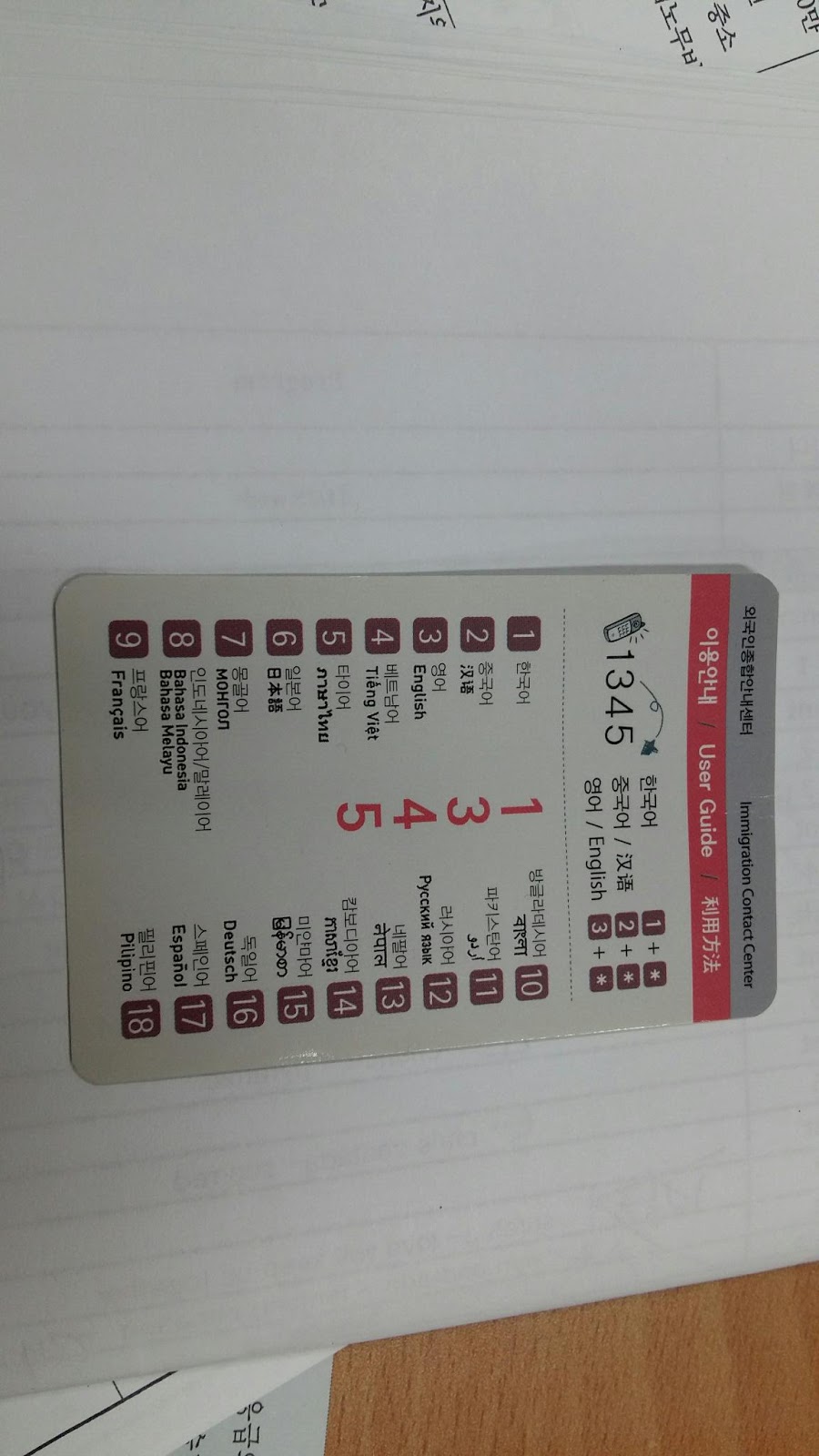
    Immigration Contact Center


    Hi ~Korea ^^ South Korea service line for foreigner & overseas Koreans hotline 1345 will help you.

    **Consultations on Immigration Affairs (Visa , Naturization)

    Dial 1345 and for the languages...
    Korean 1+*
    Chinese 2+*
    English 3+*
    Vietnam 4+*
    Thai 5+*
    Japanese 6+*
    Mongol 7+*
    Indonesia 7+*( Bahasa Indonesia  / Bahasa Melayu)
    Francias 9+*
    Bangladesh 10+*
    Pakistan 11+*
    Russia 12+*
    Nepal 13+*
    Cambodia 14+*
    Myanmar 15+*
    Deutsch 16+*
    Espanol 17+*
    Pilipino 18+*